ASCI Influencer Guidelines: What Brands in India Must Know
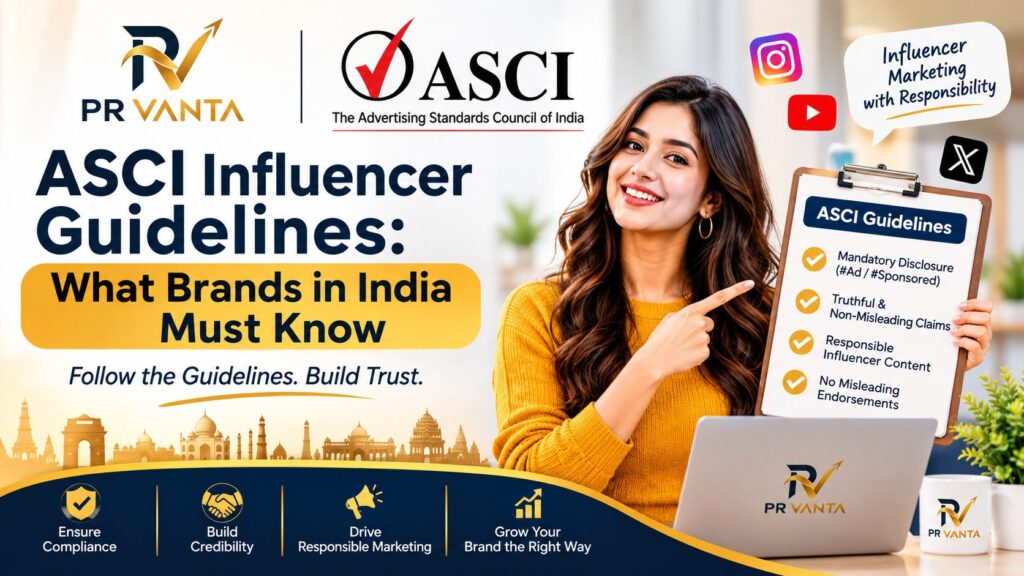
If your brand pays, gifts or otherwise rewards a creator to talk about your product, that post is an advertisement in the eyes of Indian regulators. Two sets of rules apply to it: the Advertising Standards Council of India (ASCI) Guidelines for Influencer Advertising in Digital Media, and the “Endorsements Know-hows!” guidance issued by the Department of Consumer Affairs under the Consumer Protection Act, 2019. Many brands assume disclosure is the creator’s problem. It is not. Both frameworks put responsibility on the advertiser as well.
This guide explains what the rules say, who is accountable, how virtual influencers are treated, what extra conditions apply to finance and health, and how to build compliance into your campaigns. It is general guidance, not legal advice. Guidelines are updated from time to time, so always check the latest version on ascionline.in and speak to your legal team for category-specific questions.
The Two Frameworks Brands Need to Know
ASCI Guidelines for Influencer Advertising
ASCI is India’s self-regulatory body for advertising. Its influencer guidelines were first released in 2021 and later extended through addenda, including one on health and financial influencers. They are self-regulatory rather than a statute, but ASCI monitors digital content, processes complaints and asks for non-compliant content to be modified or removed, so a finding is a reputational problem as much as a regulatory one.
CCPA “Endorsements Know-hows!”
In January 2023 the Department of Consumer Affairs released “Endorsements Know-hows!” for celebrities, influencers and virtual influencers. It sits alongside the Central Consumer Protection Authority’s (CCPA) 2022 guidelines on misleading advertisements, backed by the Consumer Protection Act, 2019, which gives the CCPA statutory powers including penalties. Both frameworks point the same way: if there is a material connection, disclose it clearly.
When Disclosure Is Required: The “Material Connection” Test
Disclosure is triggered by a material connection between the brand and the creator. ASCI defines this broadly. It is not limited to money. According to the ASCI guidelines, a material connection can include:
- Monetary payment or any other compensation
- Free products, with or without conditions attached, including products sent unsolicited
- Discounts, gifts, contest or sweepstakes entries
- Trips, hotel stays, event invitations and media barters
- Coverage, awards, and family or employment relationships
Two points catch brands out. First, gifting counts: if you run a product seeding programme and a creator posts about what you sent, the post needs a label even if you never asked for it. Second, an honest, unscripted review is still an advertisement if there is a material connection. No label is needed only when the creator bought the product themselves and has no connection with the brand.
Approved Disclosure Labels and Where to Place Them
ASCI lists the labels it accepts. Any one or more of the following can be used:
- Advertisement or Ad
- Sponsored
- Collaboration or Partnership
- Employee
- Free gift
- Affiliate
- The “Paid Partnership” tag on Instagram or the “Includes Paid Promotion” tag on YouTube
The label should be in English or in the language of the advertisement, which matters for regional influencer campaigns in Hindi, Marathi or Tamil. Vague tags such as #sp or #thanks, or #collab buried at the end of a caption, are risky because an average viewer may not understand them.
Placement rules by format
ASCI requires the disclosure to be upfront and prominent, so an average consumer cannot miss it. A label only in the bio, at the end of a long caption, after a “more” click, or hidden in a block of hashtags does not meet the standard. The specific placement rules are summarised below.
| Format | What ASCI expects |
|---|---|
| Image or video without caption (for example, Stories) | Label superimposed on the image or video, clearly visible |
| Video of 15 seconds or less | Label on screen for at least 3 seconds |
| Video longer than 15 seconds and under 2 minutes | Label on screen for one-third of the video’s length |
| Video of 2 minutes or longer | Label on screen for the whole section where the brand is discussed |
| Live stream | Announced at the beginning and end; caption label if the recording stays up |
| Audio (podcasts) | Announced at the beginning, the end, and before and after each break |
ASCI says a platform’s disclosure tool should be considered in addition to the creator’s own disclosure, so use both: the platform tag plus a clear label at the start of the caption or on screen. The CCPA guidance also asks for disclosure inside the video itself, not only in the description.
Who Is Responsible: Brand, Creator or Agency?
ASCI places responsibility on both the advertiser and the influencer. The creator is responsible for making the disclosure. The brand is responsible for making sure the posted content follows the ASCI Code and guidelines, and should ask the creator to edit or delete a post that does not. The CCPA guidance similarly expects advertisers to keep an eye on their endorsers’ compliance. If an agency is managing the campaign, it acts on the brand’s behalf, but the brand cannot hand over its accountability entirely.
The content of the post is also the brand’s responsibility. If a creator claims your product “clears acne in three days” and you cannot support it, that is a misleading claim attributed to your brand. ASCI advises influencers to check that the advertiser can substantiate its claims, and the CCPA guidance expects endorsers to have actually used what they endorse. Share approved claims in the brief and stop creators adding their own. Whether a mention is paid or earned (see influencer marketing vs influencer PR), keep a record of what each creator received. If you dispute that a post is an ad, ASCI may ask for a signed declaration from a senior person at the brand that there was no material connection.
Planning a campaign? Tell us your goal and budget, and we will send a free influencer campaign plan with suggested creators and costs. Get a free proposal →
Virtual Influencers and AI-Generated Personas
ASCI defines virtual influencers as fictional computer-generated people or avatars with realistic human characteristics who behave like influencers. They must follow every rule above and must also disclose, upfront and prominently, that the audience is not interacting with a real human being. The CCPA guidance covers them too. If you create an AI persona or hire a virtual creator, plan two labels: one for the ad and one stating the persona is not real. Rules on AI-generated content are evolving, so check ASCI’s site before launching.
Extra Rules for Finance and Health Categories
In August 2023 ASCI added an addendum for influencers in banking, financial services and insurance (BFSI) and in health and nutrition. ASCI revised it in April 2025 to separate technical advice from general promotion: as reported at the time, qualifications are required when a creator gives technical information or advice likely to be seen as expert opinion, while generic promotion by a lifestyle creator does not need formal credentials. Read the current text on ascionline.in, because the line between “technical” and “generic” is where most judgment calls sit.
Finance and investments
For technical content about stocks or investments, ASCI expects the creator to be registered with SEBI and to display the registration number with their name and qualifications. For other financial advice, suitable qualifications such as an IRDAI licence, CA or CS apply. Separately, SEBI amended its regulations in 2024 to restrict SEBI-regulated entities and their agents from associating with unregistered persons who give investment advice or make performance claims. If you are a broker, AMC or other regulated entity, your compliance team should vet every creator. Our guides on influencer marketing for fintech brands and BFSI brands cover campaign design in more detail.
Health and nutrition
For technical health and nutrition advice, the creator should hold relevant qualifications, such as a medical degree or certification as a nurse, nutritionist, dietician, physiotherapist or psychologist, depending on the advice. Qualifications should be shown upfront: on screen or as the opening remark in videos, before the text in written posts, and at the start of audio content. Beauty and personal care brands making skin or hair claims should also be careful; see our guide on influencer marketing for beauty brands.
A Practical Compliance Checklist for Brands
Use this checklist on every campaign, whether it involves five nano creators or fifty.
- Write disclosure into the contract. Specify the label, its placement and the platform tag. Include a clause that the creator will edit or remove content on request.
- Put approved claims in the brief. List what can be said and what cannot. Ask for proof behind every product claim before the brief goes out.
- Check category rules. For BFSI and health, verify qualifications and registration numbers before signing, and keep copies.
- Review drafts before posting. Check that the label is upfront, legible, in the right language and on screen for long enough.
- Label gifted and seeded content too. Tell every creator who receives product that any post should carry a label such as “Free gift” or “Ad”.
- Audit live posts. Screenshot each post after it goes live and log the label used. Fix issues within hours, not weeks.
- Keep records. Maintain a log of every payment, barter and gift for each creator, so you can respond if ASCI or the CCPA asks.
When choosing an influencer marketing agency, ask how it handles disclosure checks, claim approvals and post-live audits. At PR Vanta, a dedicated campaign manager reviews disclosures as part of content approval on every campaign.
Frequently Asked Questions
Do ASCI guidelines apply to nano influencers with small followings?
Yes. ASCI defines an influencer by their ability to affect audience decisions, not by follower count. A nano creator with 3,000 followers who posts about a free product needs to disclose it, just like a celebrity.
Is the Instagram Paid Partnership tag enough on its own?
The “Paid Partnership” tag is on ASCI’s list of accepted labels, but ASCI also says a platform’s disclosure tool should be considered in addition to the creator’s own disclosure. The safer approach is to use the tag and also place a clear label, such as “Ad” or “Collaboration”, at the start of the caption or on screen.
Does a barter or gifted product need a disclosure label?
Yes. ASCI’s definition of material connection includes free products, even unsolicited ones, as well as discounts, trips and media barters. A post about a product your brand gave should carry a label such as “Free gift”, “Ad” or “Collaboration”.
What happens if a brand’s influencer post breaks the guidelines?
ASCI can ask the brand and creator to modify or remove the content, which carries reputational cost. Under the Consumer Protection Act, the CCPA has statutory powers against misleading advertisements, including financial penalties. Consult legal counsel for your category.
Run Compliant Influencer Campaigns With PR Vanta
PR Vanta plans and manages influencer campaigns with disclosure checks, claim approvals and post-live audits built in, across nano, micro, macro and regional creators in 45+ cities. Share your brief and we will show you creators, deliverables and transparent pricing. Get a free campaign proposal.
Are you a creator? Join the PR Vanta creator network to get brand collaborations, product seeding and event invites. Register as a creator →
Get a free influencer campaign plan
Share a few details and we will reply within one working day with suggested creators, formats and a budget. No obligation.